

Ever find a piece of jewelry and get that little spark of curiosity? You know the one. The "what if this is real?" feeling. Whether you're sorting through an inherited collection in your East Cobb home or found a treasure at a market, the fastest way to start your investigation is with a simple visual check.
You're looking for two things: tiny stamps called hallmarks and any signs of strange discoloration or chipping. These clues can often tell you the whole story in just a few seconds, helping you find real designer brands at consignment value.
First Glance. Real Gold vs. Fakes.

Before you start messing with magnets or acids, your own eyes are your best tool. The biggest clue is usually hiding in plain sight, just very, very small. Whether you're browsing for men's designer consignment in Alpharetta or women's designer consignment brands in Marietta, a quick inspection reveals almost everything.
Look for the Hallmark Stamp
This is your #1 tell. A hallmark is a tiny stamp pressed into the metal, usually tucked away on the clasp of a necklace, inside a ring band, or on the post of an earring. Think of it as the jewelry world’s seal of approval, indicating the gold’s purity (its karat).
You’ll probably need good lighting and maybe even a magnifying glass to see it clearly.
I've put together this quick table to help you decode what you find. These are the most common markings you'll run across on gold jewelry from the U.S. and Europe.
Common Gold Hallmarks and Their Meanings
| Hallmark (Karat) | Hallmark (Fineness) | Gold Purity Percentage | Common In |
|---|---|---|---|
| 10K | 417 | 41.7% | Durable American jewelry like class rings and everyday wear. |
| 14K | 585 | 58.5% | The most popular choice in the U.S. for rings, chains, and bracelets. |
| 18K | 750 | 75.0% | A European standard; common in high-end, luxury designer jewelry. |
| 22K | 916 | 91.6% | Very soft and yellow; popular in Indian and Middle Eastern jewelry. |
| 24K | 999 | 99.9% | Pure gold. Too soft for most jewelry, typically found in gold bars. |
Remember, a real stamp is engraved into the metal and won’t just scratch off. Many fakes have markings that look more like they were painted on. It's a subtle but crucial difference.
Expert Tip: If you spot stamps like "HGE" (Heavy Gold Electroplate), "GP" (Gold Plated), or "GF" (Gold Filled), you're not looking at solid gold. These indicate a thin layer of gold over a less valuable base metal.
Inspect for Wear and Discoloration
Here’s another dead giveaway. Real gold is what we call a "noble metal," which means it won't rust, tarnish, or corrode. If your piece is solid gold, it should have a consistent, uniform color all the way through. Plated jewelry, on the other hand, tells a very different story over time.
Pay close attention to the high-friction areas—think about the edges of a pendant, the inside of a ring, or the links near the clasp.
See any spots where the gold color is chipping or wearing off? If you can spot a different metal peeking through underneath (often silvery, grey, or even reddish), it’s almost certainly plated. For comparison, an authentic piece like this stunning 14kt white gold diamond ring will maintain its consistent color and quality, even after years of love and wear.
This simple visual check is the perfect place to start. If an item passes this initial test, it's worth moving on to the more hands-on methods we'll cover next. And if you're ever in doubt, remember that a trusted, local expert is your best resource. Drop by our consignment store in Roswell; we see beautiful pre-owned designer fashion every day and know exactly what to look for.
Simple Home Tests. Do Them Today.
Alright, you’ve given the piece a good once-over. Now, it's time to get a little more hands-on. Don't worry, you don't need a lab coat or a fancy chemistry set for these next few steps. With a couple of things you probably already have at home, you can run some simple, non-destructive tests to get more clues.
These quick checks are perfect whether you're sorting through a jewelry box in Alpharetta or evaluating a market find in Milton. They build on what you learned from just looking and help you decide if it’s worth investigating further.
The Tell-Tale Magnet Test
This is probably the fastest and easiest way to spot an obvious fake. Go grab a magnet—not a weak one off your fridge, though. You’ll want something with a bit of pull.
Now, hold that magnet right up to your jewelry.
Real gold is not magnetic. If your ring, chain, or bracelet snaps right to the magnet, that’s a huge red flag. A strong attraction means the piece is almost certainly made from a ferrous metal (which contains iron) and is, at best, gold-plated.
But hold on, there are two things to keep in mind:
- The Clasp Exception: Sometimes, just the clasp on a necklace or bracelet has a tiny steel spring inside, which is magnetic. Make sure you test the main body of the piece, not just the part that fastens it.
- Non-Magnetic Fakes: Not all fakes are magnetic. Counterfeiters often use non-magnetic metals like brass or copper as a base. So if your jewelry doesn't stick, it just means it passed round one. It's not a guarantee of authenticity.
What Your Skin is Telling You
Ever worn a ring or necklace and ended up with a green or black smudge on your skin? Most people jump to the conclusion that the jewelry must be fake, but the truth is a little more complicated.
Real gold itself won't tarnish or react with your skin. The thing is, most gold jewelry isn't pure 24K. It’s an alloy, meaning it’s mixed with other metals—like copper, silver, or nickel—to make it stronger. It's those other metals that can react with your skin's pH, sweat, or even lotions, leaving that tell-tale mark.
This reaction is way more common with lower-karat gold (like 10K or 14K) because they have a higher percentage of those other metals mixed in. So, while a skin reaction means it's definitely not pure gold, it doesn't automatically mean it's fake. It just points to a lot of alloy metals in the mix.
Local Insight: Here in the warm Georgia climate, especially during our humid summers from Roswell to Forsyth County, it’s even more common for skin to react with jewelry alloys. You know what we're talking about! Think of a skin reaction as a clue, not a final verdict.
The Sound and Feel Check
This last one is a bit more subjective, but seasoned jewelry lovers and collectors swear by it. It’s all about tuning into the physical properties of the piece.
First, listen. Gently drop your jewelry from a short distance onto a hard, clean surface like a glass tabletop. Real, solid gold has a unique density that produces a distinct, high-pitched, almost bell-like ringing sound. Most fake metals, by contrast, will land with a duller, shorter "thud." Try this with a piece you know is genuine and another you suspect is fake to really hear the difference.
Next, feel the weight. Gold is one of the densest metals out there. A solid gold piece should feel surprisingly heavy for its size. If you pick up a chunky-looking chain that feels unexpectedly light or flimsy, your gut is probably right—it's likely hollow or made from a much less dense base metal. It's that satisfying, substantial heft that gives real designer jewelry its luxurious feel.
These simple at-home tests are your next line of defense. If your jewelry passes all of them, it’s time to move on to some of the more scientific methods.
The Density Test. Get Accurate Results.
When a visual inspection or a quick magnet test doesn't quite cut it, it's time to bring a little science into the picture. The density test, also known as the water displacement method, is one of the most reliable DIY techniques you can try. It might sound like something out of a high school chemistry class, but it's surprisingly straightforward.
The whole method hinges on a simple, fundamental fact: gold is incredibly dense.
A real gold ring will feel significantly heavier than a fake one of the exact same size made from a less dense metal. It’s a physical property that’s tough for counterfeiters to mimic, which is why you’ll often see this test used in pawn shops and by professionals. All you need is a digital scale that measures in grams, a container of water, and a calculator.
The Simple Science Behind the Test
The goal here is to calculate your jewelry's density (that’s its mass divided by its volume) and then compare it to the known density of gold. You'll measure its weight out of the water, and then its weight while it's submerged. The difference between those two numbers cleverly reveals its volume—a neat little physics trick discovered by Archimedes himself.
From there, a simple formula gives you the answer you need.
This infographic breaks down some of the simple home tests you might perform before moving on to a more advanced method like this one.
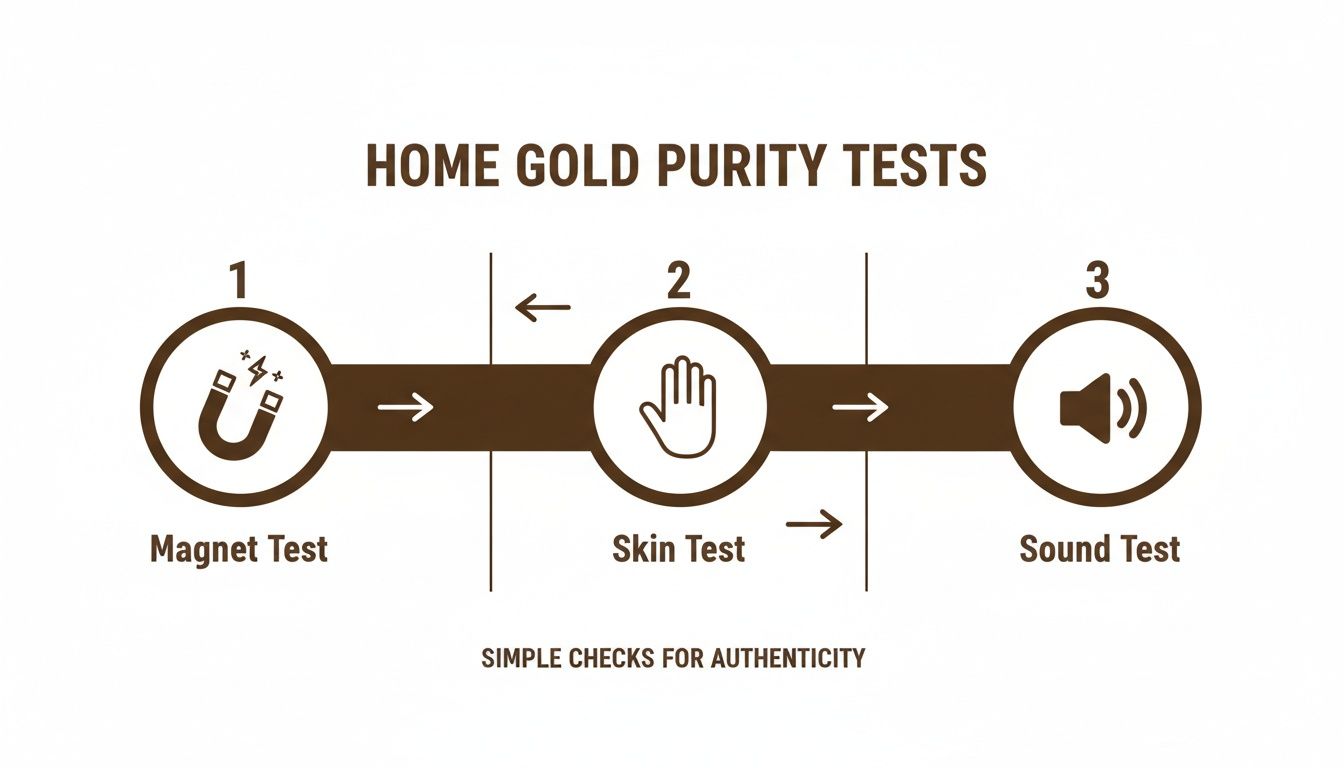
Think of these preliminary checks as a way to quickly weed out the obvious fakes before you invest the time in a more precise density measurement.
Performing the Water Displacement Test
Ready to give it a shot? Here’s how it works:
-
Weigh it Dry: First things first, place your jewelry on the digital scale and jot down its weight in grams. This is your "weight in air."
-
Prep the Water: Place a cup or beaker of water on the scale and press the "tare" button to zero it out. This step is crucial because it ensures you're only measuring the weight of the water your jewelry displaces, not the water or the container.
-
Weigh it Wet: Now, carefully suspend your jewelry in the water. You want it fully submerged but not touching the bottom or sides of the container. A piece of string or a bent paperclip is perfect for this. The scale will show a negative number, which is the weight of the displaced water. Record this number, but just ignore the negative sign.
-
Do the Math: Finally, plug your numbers into this simple formula:
Density = Weight in Air / Weight in Water
The result is your jewelry's density in grams per cubic centimeter (g/cm³).
For example, let's say your ring weighs 10 grams in the air and its weight in water is 0.7 grams. The math is 10 divided by 0.7, which equals 14.28 g/cm³. That number falls squarely in the range for 14K gold.
Interpreting Your Results
Now, take your calculated density and see how it stacks up against the known densities of different gold karats.
- 10K Gold: 11.0 - 11.6 g/cm³
- 14K Gold: 12.9 - 14.6 g/cm³
- 18K Gold: 15.2 - 15.9 g/cm³
- 22K Gold: 17.7 - 17.9 g/cm³
- 24K Gold (Pure): 19.3 g/cm³
If your number lands within one of these ranges, it’s a very strong sign that you have real gold on your hands. Funnily enough, the old movie trope of biting gold was based on a similar idea of material properties. Pure gold scores just 2.5-3 on the Mohs hardness scale, making it soft enough to dent with your teeth, unlike harder fakes.
Today, density testing is a much more reliable (and less destructive) method. Gold's specific gravity is 19.32 g/cm³, making it far denser than common impostor materials like silver (10.49) or copper (8.96). You can dive deeper into the scientific methods for determining gold content in this detailed guide.
Get Serious. Use an Acid Test Kit.

So, you’ve tried the at-home checks, and your piece passed with flying colors. Great! Now it's time to bring out the classic jeweler's method. The acid test is one of the most reliable ways to confirm if gold is real, but you absolutely have to be careful and use the right tools. For generations, this is how the pros have separated the genuine from the junk.
You can find these kits online pretty easily. They usually include a testing stone (often a piece of black slate) and several small bottles of nitric acid. Each bottle is calibrated for a specific karat, like 10K, 14K, and 18K. The whole thing feels a bit like a science experiment, but the chemical reaction will tell you the truth about your metal's makeup.
First Things First: Prep Your Space
Before you even think about unscrewing a cap, let's talk safety. The acid in these kits is no joke—it's corrosive and can easily irritate your skin or ruin surfaces if you're not careful.
- Get Some Airflow: Crack a window or turn on a fan. You don't want to be breathing in any fumes.
- Protect Your Table: Lay down newspaper or a protective mat. A single drop of this stuff can stain or etch wood, laminate, or even stone countertops.
- Gear Up: Always wear gloves. The kit might come with a pair, but any latex or nitrile gloves will do. Protective eyewear is a really smart move, too.
Once your workspace is ready, you can prepare the jewelry for its moment of truth.
The Right Way to Scratch and Test
Here's the most important rule: never, ever apply the acid directly to your jewelry. This is a fast way to damage a precious item. Instead, you'll use the testing stone that came with your kit.
Find an inconspicuous spot on your jewelry—like the inside of a ring or near the clasp—and gently but firmly rub it against the stone. You’re aiming to create a small, visible streak of metal on the stone’s surface. This transfers just enough of the metal for testing without hurting the piece. If you want to test against multiple karat levels, make a few parallel streaks.
Now for the test. Choose the acid that matches the karat you think the piece is. If your necklace is stamped "14K," start with the 14K acid solution and apply a single drop right onto the streak you made.
Key Takeaway: The reaction—or lack of one—tells you everything you need to know. If the metal streak on the stone stays put and doesn't change color, your jewelry is at least that karat, maybe even higher. If it fizzes, turns a weird color, or dissolves completely, you're looking at a lower karat or, more likely, simple gold plating.
There's a reason the acid test has been a go-to for so long: it works. It quickly dissolves the fakes while genuine gold stands strong. In skilled hands, this method can be 85-95% accurate. Still, professionals often combine it with other techniques to be absolutely certain. In a world where fakes are getting more convincing, this simple test gives you a real defense. If you're interested in how experts authenticate high-value items, you can learn more about luxury goods authentication here.
Of course, if you're still not sure or you're dealing with what could be a high-value designer piece, don't risk it. The smartest move is always to get an expert opinion. For those of us in the Roswell, Milton, or Cumming areas, bringing your jewelry to a trusted consignment expert like Board of Trade guarantees a safe, accurate evaluation with zero guesswork on your part.
When To Call A Pro.
While DIY tests are fantastic for getting a good idea of what you have, there are moments when "pretty sure" just isn't enough.
If you’re holding a potential high-value antique, a piece with large or intricate gemstones, or you simply crave 100% certainty, it’s time to call in the professionals. Stepping up from at-home methods to a professional appraisal is the only way to get a definitive, legally recognized valuation.
This is especially true for those of us in the North Atlanta suburbs. Whether you've inherited a piece in Marietta or found something special at an estate sale in Forsyth County, knowing its true nature is key. A professional appraisal isn't just about authenticity—it's about understanding the full story and value of your piece.
Beyond the Basics: Advanced Tools of the Trade
When you bring a piece to a trusted expert, they won’t be using a kitchen magnet or a bottle of vinegar. Professionals have access to advanced, non-damaging technology that provides instant and precise results. One of the most common tools is an X-Ray Fluorescence (XRF) scanner.
This impressive device looks a bit like a price scanner at a grocery store, but it’s far more powerful. It sends X-rays into the jewelry, which causes the atoms in the metal to get excited and emit their own unique energy signatures. The scanner reads these signatures and can tell you the exact elemental composition of your piece down to the decimal point—without leaving so much as a scratch.
- Instant Precision: An XRF scan can confirm in seconds if a piece is 14.01% copper, 58.53% gold, and 27.46% silver.
- Safety First: It's completely non-destructive, making it perfect for delicate antiques or items with intricate designs.
- Detects Plating: It can even detect gold plating by identifying the different metals layered on top of one another.
This level of detail is something no home test can replicate, providing total peace of mind.
Why a Local Expert in Roswell Matters
For residents of Roswell, Milton, and East Cobb, having a trusted local resource is invaluable. You don’t want to mail a precious heirloom to an unknown entity. You want face-to-face interaction with someone who understands the local market and values community trust.
At Board of Trade Fine Consignments, we provide a curated and reliable environment to assess your designer and fine jewelry. We combine years of hands-on experience with an appreciation for the craftsmanship of luxury brands. Think of the quality you'd find at Avalon or in Downtown Alpharetta—we specialize in bringing that same level of designer style to our Roswell showroom, but at a consignment value.
A professional opinion does more than just confirm the karat of your gold; it provides context. An appraiser can identify the maker, the time period, and any unique characteristics that contribute to its overall worth, ensuring you don't undersell a rare find.
DIY Testing vs Professional Appraisal
To help you decide on your next step, here’s a quick comparison of what you can achieve at home versus what an expert can provide.
| Method | Best For | Accuracy Level | Risk of Damage |
|---|---|---|---|
| DIY Home Tests | Quick screening, identifying obvious fakes, initial curiosity. | Moderate to High (if done correctly) | Low to Moderate |
| Professional Appraisal | Insurance purposes, resale, antique identification, high-value items. | Extremely High (often legally certified) | Virtually None |
Ultimately, getting an expert opinion confirms the true value of your treasures.
Beyond the basic tests for real gold, you might also want to learn how to identify valuable antiques, as many gold pieces hold historical significance that requires specialized knowledge. Understanding the full picture is crucial, especially if you're considering selling. To get a better idea of your options, you can explore our guide on selling jewelry on consignment, which outlines the process and its benefits.
Don't risk damaging a family heirloom or undervaluing a designer piece. If you have any doubts, the answer is clear. Visit us in Roswell to have your pre-owned designer jewelry evaluated today and unlock its true potential.
Got Questions? We've Got Answers.
After digging into hallmarks, home tests, and professional appraisals, you probably still have a few questions rolling around. That’s perfectly normal. When you're trying to figure out if a piece of jewelry is real gold or just a convincing fake, a little extra clarity goes a long way.
We've pulled together some of the most common questions we hear from clients in our Roswell consignment store and around the North Atlanta suburbs. Here are the straightforward answers you're looking for.
Can Real Gold Jewelry Turn Your Skin Black or Green?
Yes, it absolutely can—but it’s not the gold’s fault. Pure 24K gold is famously non-reactive. The thing is, most jewelry isn’t made from pure gold because it’s too soft for daily wear. Instead, it’s an alloy, which just means pure gold is mixed with other metals like copper, silver, or nickel to make it stronger.
It’s those other metals that can react with your skin's unique chemistry, sweat, or even the lotions and perfumes you use. This reaction is what causes that harmless, temporary discoloration. It happens more often with lower-karat gold (like 10K) because it contains a higher percentage of these other metals. So, while it's a clue, it doesn't automatically mean your jewelry is fake.
What Do Stamps Like HGE or GP Mean?
Spotting these markings is a game-changer because they tell you right away that the piece is not solid gold.
- HGE stands for "Heavy Gold Electroplate."
- GP means "Gold Plated."
- GF indicates "Gold Filled."
All these stamps mean the item is made of a less expensive base metal (like brass or copper) with a super-thin layer of gold applied to the surface. While it has a tiny amount of real gold, its value is minimal compared to a solid piece. Over time, that plating will inevitably wear away, revealing the different colored metal underneath.
Local Insight: If you're exploring consignment stores from Marietta to Forsyth County, knowing these marks is crucial. It’s the fastest way to separate the high-value finds from the fashionable costume jewelry.
Is White Gold Actually Real Gold?
Absolutely. White gold is a genuine gold alloy. It’s made by mixing pure yellow gold with white metals like palladium, nickel, or manganese. This blend is what creates its beautiful, silvery-white hue.
To give it that extra brilliant shine and add a layer of protection, most white gold jewelry is also plated with rhodium—a hard, lustrous metal from the platinum family. If you see a hallmark like "14K" or "750" on a white-colored piece, you can feel confident it's the real deal.
What if My Gold Jewelry Has No Hallmark Stamp?
Don't panic—it doesn't automatically mean it's fake. While most modern jewelry sold in the U.S. is legally required to be stamped, there are several good reasons a piece might be unmarked.
For example, many older pieces, especially what might be considered what is estate jewelry, were created long before stamping became a widespread standard. The stamp on a well-loved ring or bracelet can also simply wear off after decades of use, and custom-made items sometimes skip the hallmark altogether.
To really get a feel for what your gold might be worth, it helps to know the current market rates. For a great breakdown, you can learn more about how much gold is per gram from trusted experts. If you have an unstamped piece you believe is genuine, it’s the perfect time to run the other tests in this guide or, for a definitive answer, bring it to an expert in Roswell for a professional evaluation.
At Board of Trade Fine Consignments, we're here to help you navigate the world of designer and fine jewelry with confidence. Drop by our showroom in Roswell to browse our curated collection or to get an expert opinion on your own treasured pieces. Find your next designer piece today by visiting us at https://www.goboardoftrade.com.