

Dating a piece of vintage jewelry really comes down to three things: its style, construction, and markings. You can often pinpoint a piece’s age just by looking at its design era (think the sharp, geometric patterns of Art Deco), the type of clasp it has (an old C-clasp is a dead giveaway for Victorian origins), and the tiny hallmarks stamped into the metal that tell you its purity and maker.
Uncover Hidden Gems. Right Here in Roswell.
Ever found yourself staring at a brooch in your grandmother's jewelry box, wondering if it's a priceless antique or just a pretty trinket? You're not alone. Figuring out what’s what can feel like a treasure hunt, but once you know the signs, you can learn to spot the real deal.
This guide is your map. We'll walk you through the essential signs of age, craftsmanship, and authenticity that turn a casual browser into a confident collector.
Think of this as your personal consultation before you even step into our store. Whether you're sifting through estate sales in Alpharetta or browsing the curated cases at Board of Trade, our Roswell consignment store, you'll soon know what to look for. From the tiny stamps that tell a story to the style of a clasp that reveals its age, get ready to unlock the secrets behind every sparkle.
A Journey Through Jewelry History
The first real step is understanding that jewelry styles changed dramatically from one decade to the next. Just like fashion, jewelry is a reflection of the culture, technology, and art of its time. Learning to recognize the signature look of an era is your most powerful tool.
You wouldn't mistake a flapper dress from the 1920s for a bell-bottom jumpsuit from the 1970s, right? The same visual clues apply here. Certain motifs, materials, and silhouettes are tell-tale signs of a specific period.
For example, if you find a piece with flowing, nature-inspired lines and delicate enamel work, you might be holding an Art Nouveau treasure. On the other hand, a piece with bold, symmetrical lines and high-contrast colors like black onyx and diamonds absolutely screams Art Deco. Knowing these key differences is everything.
Pro Tip: Don't just look at the front of the piece. The back, the clasp, and the way the stones are set often tell you more about its age and authenticity than the main design itself.
This quick timeline offers a visual shortcut to the dominant styles you'll run into.
This visual guide shows just how dramatically jewelry design evolved, from the sentimental motifs of the Victorian era to the bold, glamorous statements of the Retro period. To make it even easier, here's a quick cheat sheet.
Quick Guide to Vintage Jewelry Eras
This table breaks down the defining features of major jewelry periods, helping you quickly spot the characteristics of a potential find.
| Era | Approximate Years | Common Metals | Signature Motifs & Stones |
|---|---|---|---|
| Victorian | 1837-1901 | Yellow Gold, Silver | Snakes, hearts, flowers, mourning motifs; Garnets, Turquoise, Seed Pearls |
| Art Nouveau | 1890-1910 | Yellow Gold, Silver | Flowing lines, nature, female form; Enamel, Moonstone, Opal |
| Edwardian | 1901-1910 | Platinum, Yellow Gold | Delicate lace, bows, garlands; Diamonds, Pearls, Sapphires |
| Art Deco | 1920-1935 | Platinum, White Gold | Geometric shapes, symmetry; Diamonds, Onyx, Jade, Coral |
| Retro | 1935-1950 | Rose & Yellow Gold | Big, bold, Hollywood glamour; Rubies, Sapphires, Citrine, Aquamarine |
Getting familiar with these key looks will sharpen your eye and give you a huge advantage when you're out hunting for treasures.
More Than Just a Pretty Piece
Understanding these eras does more than just help you put a date on an item; it connects you to its story. When you can confidently identify a piece of designer consignment from the Retro '40s, you appreciate its use of rose gold—a direct result of wartime platinum restrictions. It’s this rich history that elevates a piece from a simple accessory to a wearable artifact.
At Board of Trade, we celebrate these stories. Our curated collection of pre-owned designer fashion and jewelry in Roswell, GA, is filled with authenticated treasures from various periods. We provide the quality you’d expect at Avalon or in Downtown Alpharetta but with the exceptional value that only consignment offers.
For shoppers in Milton, East Cobb, and Forsyth County, our showroom is a convenient place to explore these historical styles firsthand. Drop by and see the difference for yourself.
Decode the Secrets. Find the Value.
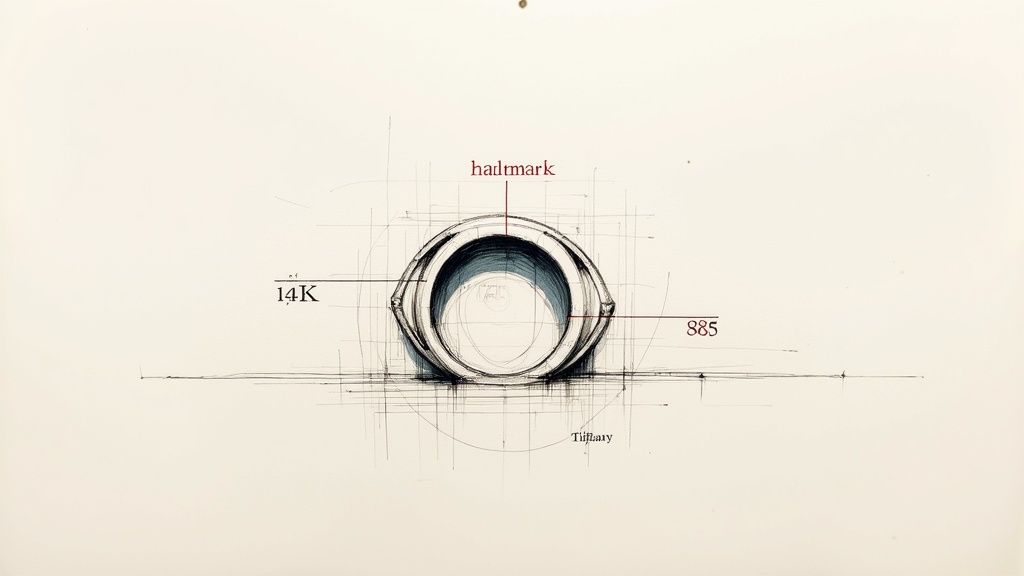
The quickest way to get a read on a vintage piece is to find its signature. I'm talking about hallmarks and maker's marks—the tiny engravings that act like a passport, telling you where the jewelry came from, what it’s made of, and who made it. These little stamps are often the only thing separating a $50 flea market find from a $5,000 treasure.
These clues are almost always tucked away on a clasp, the back of a pin, or the inner band of a ring. To get a good look, you’ll need a jeweler's loupe. It’s just a small magnifying glass, but it’s the single most important tool for any serious vintage hunter. It lets you see the fine details that are completely invisible to the naked eye.
Once you have your loupe, the real detective work begins. Learning to read these marks is a game-changer, whether you're building a personal collection or thinking about consigning a family heirloom right here in the Milton or East Cobb area.
Cracking the Code of Metal Purity
One of the first things you'll spot is a hallmark for metal purity. This stamp is a guarantee of the precious metal content, giving you instant confidence in what you’re holding.
Here are the key marks to look for:
- Gold Marks: In American pieces, you'll often see "14K" or "18K." European jewelry tends to use a number system, where "585" means 14K gold (58.5% pure) and "750" means 18K gold (75% pure).
- Silver Marks: The universal stamp for sterling silver is "925," which means the piece is 92.5% pure silver. Sometimes you'll just see the word "Sterling" or "Ster."
- Platinum Marks: Keep an eye out for "PLAT," "PLATINUM," or "950." This tells you the piece is 95% pure platinum, a favorite metal during the elegant Edwardian and Art Deco periods.
Decoding these intricate marks often requires knowing where they came from. For example, understanding specific Italian Jewelry Marks can help you place a piece not just in an era, but on a map.
Identifying the Maker's Signature
Beyond the metal content, the most exciting finds are the maker's marks. These are the unique logos or signatures of the designer or company. It could be a simple initial, a full name, or a tiny symbol, but finding one can dramatically boost a piece's value.
A genuine Tiffany & Co. stamp, for example, can increase a brooch's value by up to 300% compared to a similar unmarked piece. This is the kind of detail that turns a great find into a true investment.
Identifying these signatures connects your jewelry to a prestigious history. Brands like Cartier, Van Cleef & Arpels, or even well-loved local jewelers from a bygone era all used their own specific marks. A little research here can unlock the entire story behind your piece.
Hallmarks are the cornerstone of authenticating vintage jewelry. They tell a story that directly impacts value—Sotheby's sales data from 2023 showed signed Art Deco pieces fetching averages of $15,000 versus just $4,500 for unsigned lookalikes. Antique dealer guides suggest 80% of authentic vintage items have these clues hiding in plain sight, usually on clasps or inner bands.
Bringing Your Finds to a Trusted Source
Once you've done some digging, it’s always a good idea to get an expert opinion. Here at Board of Trade, our Roswell consignment store is a hub for jewelry lovers from Alpharetta, Marietta, and all over Forsyth County. We have the experience to help you figure out what those newfound marks really mean.
We carefully curate our collection of women's and men's designer consignment, and we have a real passion for fine jewelry. We bring the quality of an Avalon boutique to our community but with the smart value that only consignment offers. Whether you want to consign a family heirloom or find your next designer piece, our team is here to help. Drop by our showroom and let's decode those secrets together.
Look Beyond the Bling. Read the Build.
Long before hallmarks became standard practice, the way a piece of jewelry was built was its signature. The style of a clasp, the setting of a stone, or the pin on a brooch can date an item with surprising accuracy. Think of it like a vintage car; you know a Model T wasn't made in the 80s just by looking at its frame and engine. The same logic applies here.
This construction tells a story about the technology, tools, and artistry of a specific time. Hand-finished details, unique settings, and even the subtle imperfections are the fingerprints of a human touch—something you just don't find in modern, mass-produced jewelry. It’s this expert knowledge we use at Board of Trade to curate our collection, ensuring every piece of pre-owned designer fashion is authentic and has a story to tell.
What Clasps and Fasteners Can Tell You
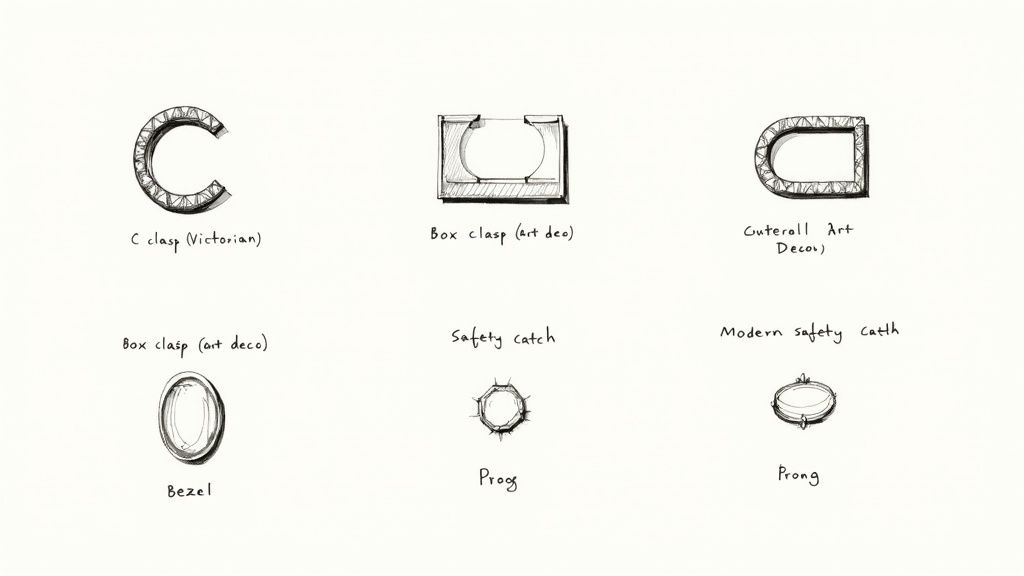
The clasp on a necklace or the back of a brooch is one of the most reliable clues to its age. These little mechanisms evolved over the decades for both security and style, leaving behind a clear timeline for us to follow. Finding a piece with its original, period-correct clasp is a huge win for a collector.
A simple, open "C-clasp" on a brooch, for example, points directly to the Victorian era or even earlier. Later on, safety catches were added to make them more secure. Another classic tell for a pre-20th-century piece is a long pin that extends well past the body of the brooch itself.
Here are a few other common clasps and their associated eras to keep an eye out for:
- Spring Ring Clasp: Invented around the early 1900s, this simple circular clasp became a staple of early 20th-century jewelry.
- Box Clasp: Popular during the Art Deco period, this elegant clasp features a small tab that clicks securely into a decorative boxy housing.
- Fold-Over Clasp: This familiar, hinged clasp became widespread in the mid-20th century and remains one of the most common types today.
- Screw-Back Earrings: Before pierced ears became the norm, these were the go-to style from the Victorian era all the way through the 1950s.
The clasp isn’t just a detail; it’s a crucial piece of the puzzle. A mismatched or replaced clasp can drop a piece's value by 30-60%, which is why our Roswell team authenticates every single component before it hits the showroom floor.
These fasteners are remarkably precise dating tools. For instance, pre-1920 Edwardian pieces often used simple C-clasps, while by the Art Deco era, box clasps appeared in 65% of surviving Cartier necklaces from that decade. A modern clasp on an older piece is a major red flag for a repair or alteration—something savvy shoppers from Alpharetta to Marietta know to look for. To dive deeper into how experts evaluate these tiny details, check out the guides at Bellamy's World.
The Secrets Hidden in Stone Settings and Cuts
The way a gemstone is cut and held in place also reveals its age. Modern gems are often laser-cut for flawless symmetry and blinding brilliance, but vintage stones were meticulously cut by hand, giving them a unique charm and character you can't replicate.
Look for slightly imperfect facets or asymmetrical shapes. Old Mine Cut and Rose Cut diamonds, for example, have a soft, romantic glow that is entirely different from the fiery sparkle of a modern Brilliant Cut. These older cuts were masterfully designed to look their best in candlelight.
The setting that cradles the stone is just as important:
- Bezel Setting: One of the oldest setting styles, where a solid rim of metal fully encircles the stone to hold it securely.
- Collet Setting: A specific type of bezel setting with a closed back, very common in Georgian and Victorian jewelry.
- Prong Setting: This innovation became popular in the late 19th century and was a game-changer, allowing more light to enter the stone and dramatically increasing its sparkle.
- Pave and Channel Settings: These intricate settings, where stones are set closely together with minimal visible metal, were hallmarks of the Art Deco and Retro eras.
Examining these construction details is your best defense against spotting fakes or pieces that have been "Frankensteined" with modern parts. When you visit Board of Trade, conveniently located for shoppers in East Cobb and Forsyth County, you can see these historical techniques up close. Come browse our racks and find your next authentic designer piece today.
Learn the Language of Style.
Every era left its own signature on jewelry, almost like a distinct art movement. Learning to spot these tells is the fun part. Is that brooch a flowing, nature-inspired Art Nouveau piece? Or does it have the sharp, geometric confidence of Art Deco?
Knowing the difference helps you place a piece in its historical context, making the hunt for treasures that much more rewarding. More importantly, it’s what keeps you from overpaying for a modern reproduction that’s just trying to look old.
A Quick Visual Guide to Jewelry Periods
Every design period speaks its own language. Once you start to pick it up, you’ll see the clues everywhere—from the motifs in a necklace to the specific shade of gold in a ring. It’s an essential skill for anyone looking to find authentic designer brands at a consignment price.
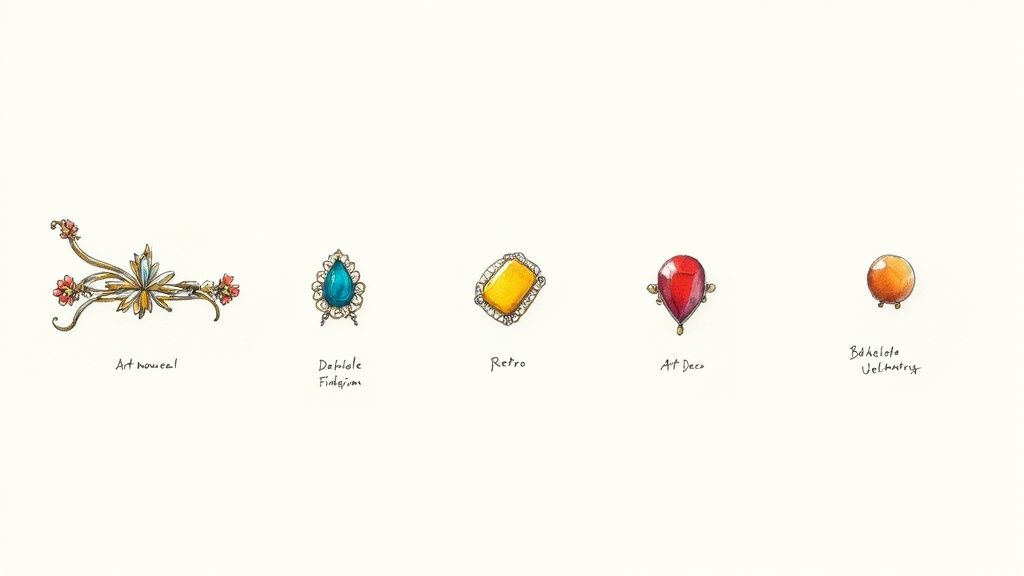
Here’s a quick rundown of the major styles you’ll come across:
- Victorian (1837–1901): Think sentimental, symbolic, and often elaborate. You'll see a lot of yellow gold with motifs like snakes, hearts, and flowers. Mourning jewelry was also a huge part of this era, often made with black materials like jet or onyx.
- Art Nouveau (1890–1910): This was a rebellion against Victorian stiffness. Look for flowing, organic lines inspired by nature—insects, whiplash curves, and feminine forms—frequently brought to life with delicate enamel and moonstones.
- Edwardian (1901–1910): Elegance and light were everything. Platinum became the metal of choice, allowing for incredibly fine, lace-like metalwork known as filigree. Bows, garlands, and tassels dripping with diamonds and pearls are classic tells.
- Art Deco (1920–1935): A total pivot from the past. This period was all about bold symmetry, clean lines, and sharp geometric shapes. Think platinum and white gold paired with high-contrast gemstones like diamonds, onyx, jade, and coral.
- Retro (1935–1950): Hollywood glamour takes the stage. Jewelry got big, bold, and colorful. Rose gold saw a surge in popularity due to wartime restrictions on platinum, and designers loved using large, vibrant stones like citrine and aquamarine.
Recognizing these eras is about more than just aesthetics; it connects a piece to a specific moment in history. To really get a feel for the subtle differences, our guide on what is estate jewelry is a great next step.
Let the Materials Tell Their Story
The materials in a piece can be just as revealing as its design. Certain metals and stones spiked in popularity during specific decades, leaving behind a clear trail for us to follow today.
Take the Great Depression and Art Deco eras, for example. Designers got incredibly creative with new, more accessible materials. Bakelite and celluloid, two early forms of plastic, were carved into imaginative, colorful bangles, brooches, and beads. Finding a genuine Bakelite piece now is a real treat for any collector.
The post-war Mid-Century period shifted back to chunky gold and vibrant, abstract designs. Fast forward to the 1970s, and there was an obsession with textured yellow gold and earthy stones like turquoise, malachite, and tiger's eye. This kind of knowledge changes everything, whether you're at an estate sale or browsing our Roswell showroom. For more visual inspiration, you can even explore resources on unforgettable vintage photoshoot ideas, spanning from 1920s Art Deco to '90s grunge.
Patina is Your Friend. Fakes Are Not.
The best vintage pieces show their age with grace. That soft glow or gentle tarnish metal gets over the years—what we call patina—is actually a huge plus! It tells the story of where a piece has been and is incredibly difficult for forgers to replicate convincingly.
Learning to see the difference between genuine age and a quick, artificial distressing job is one of the most important skills you can develop. A true patina is the result of a slow chemical reaction with air and skin over decades, creating a warm, subtle finish that speaks of a life well-lived.
This is exactly the kind of history we hunt for at Board of Trade. When we're curating our Roswell consignment collection for customers in Marietta, Alpharetta, and the surrounding communities, we want items with a real story, not just something that looks old.
What Real Patina Looks Like
Patina isn’t just dirt; it's a soft, mellowing of the surface that gives vintage jewelry its one-of-a-kind character. On silver, it’s a gentle darkening in the crevices, not a harsh, uniform black paint job created by chemicals. On gold, it develops into a deep, warm luster that brand-new pieces simply can’t match.
Distinguishing between natural age and a fake finish is easier than you might think once you know what to look for. Chemically aged pieces often have a flat, even blackness that looks painted on. Authentic patina, on the other hand, is always uneven. It will be darker in recessed areas and naturally worn away on high-contact points, like the edges of a setting or the back of a ring band.
True patina is inconsistent. It reflects decades of being worn, handled, and loved. A perfectly uniform tarnish is almost always a red flag for a modern reproduction.
Developing your eye for these subtleties is what protects your investment. To get even more familiar with what authentic metals look like, check out our guide on how to tell real gold jewelry.
Reading the Signs of Natural Wear
Beyond the patina, look at how the entire piece has aged. Genuine wear happens logically, showing up on the parts of the jewelry that would have seen the most action over the years.
Here’s a quick checklist of what to look for:
- Softened Edges: Sharp, crisp edges on a supposedly antique piece are suspicious. Decades of being worn will naturally soften and round the corners and high points.
- Worn Prongs: The little metal claws holding a gemstone should show some gentle wear. If the prongs look brand new and sharp on an otherwise old-looking ring, it could mean a stone was replaced—or the whole thing is a fake.
- A Fine Network of Scratches: A lifetime of wear leaves behind a web of tiny, random scratches, sometimes called a "butler's finish." This looks very different from the uniform, parallel lines left by modern sandpaper or distressing tools.
Examining these wear patterns is a core part of separating the real deal from the knock-offs. Research shows that 92% of true antiques over 75 years old develop a noticeable patina from prolonged contact with air and skin. This natural aging process creates unique tones—from green verdigris on silver to that mellow glow on gold—that stand in stark contrast to the flat gleam of modern copies.
Spotting Red Flags and Inconsistencies
The final step is to put all the clues together. A truly authentic piece should tell a consistent story in its style, construction, and wear. When details don't match up, it’s often a sign of a shoddy repair, a "marriage" of different pieces, or an outright forgery.
Start asking yourself some critical questions:
- Does that "Victorian" brooch have a modern safety clasp on the back?
- Are the stones in an "Edwardian" ring laser-cut with flawless modern facets?
- Does the maker's mark look too crisp and new for the supposed age of the piece?
These inconsistencies are your biggest clues. At Board of Trade, we provide a trusted shopping experience for our clients from East Cobb, Milton, and Forsyth County because we obsess over these details. We bring the curated quality of an Avalon boutique right here to Roswell—but with the fantastic value only consignment can offer. Drop by and see our authenticated collection for yourself.
Find Your Next Treasure in Roswell.
You've learned the ropes—how to spot the tell-tale signs of an era, decipher cryptic hallmarks, and tell a true antique from a clever modern knock-off. Now for the best part: the hunt.
Putting that knowledge into practice is how you really sharpen your skills. And while digging through flea market bins can be a thrill, the fastest way to train your eye is to start with a curated collection where the guesswork has already been handled. You get to see, touch, and compare authentic pieces side-by-side.
Your Local Source for Designer Consignment
At Board of Trade in Roswell, we live for this stuff. Our cases are filled with a hand-selected, always-changing inventory of pre-owned designer jewelry, alongside men’s and women’s designer fashion and one-of-a-kind home decor. We bring that high-end, Avalon-quality feel to our neighborhood, but with the unmatched value that only consignment can deliver.
If the world of pre-owned luxury is new to you, we've got you covered. Our guide on what is consignment shopping breaks it all down and is a great place to start.
The real magic of consignment isn't just saving money—it's the thrill of discovery. You find designer quality and a piece with a story, something truly unique that you won't see on everyone else.
We're just a short drive for shoppers in Marietta, Milton, Alpharetta, East Cobb, Cumming, and Forsyth County. So come on by and put your new skills to the test. Browse our racks, ask us questions, and find a piece that feels like it was waiting just for you.
Your next treasure is right here. Visit us in Roswell and let the hunt begin.
Got Questions? We've Got Answers
If you're just starting your journey into vintage jewelry, you probably have a few questions. These are some of the most common ones we hear from new collectors and customers who stop by our Roswell consignment shop.
What’s the Real Difference Between “Antique” and “Vintage” Jewelry?
That’s a great question, and you’ll hear these terms thrown around a lot, sometimes incorrectly. In the jewelry world, it all comes down to a number.
- Antique is the designation for pieces that are 100 years or older. That beautiful Art Deco diamond ring from 1922? It just crossed the threshold and is now officially an antique.
- Vintage generally describes anything that's at least 20-50 years old but hasn't hit that century mark yet. A bold, chunky gold bracelet from the 1970s is a perfect example of a classic vintage find.
Both are incredibly collectible, each telling the story of its own unique decade. When you browse the cases at our Roswell consignment store, you'll find stunning examples from various periods, right here for shoppers from Milton to Marietta.
Should I Clean My Vintage Jewelry?
My advice? Tread very, very carefully here. It’s always tempting to polish an old piece until it sparkles like new, but you could be doing serious damage. Aggressive cleaning can easily strip away the patina—that soft, beautiful finish that only comes with age and is highly prized by collectors. Wiping it away can literally wipe away value.
For most jewelry, a gentle buff with a soft, dry cloth is all you need. Never, ever submerge antique pieces in harsh chemical dips or toss them in an ultrasonic cleaner, especially if they have soft or porous stones like pearls, opals, coral, or emeralds. When in doubt, the absolute safest bet is to ask a professional jeweler or just bring it by our store for some advice.
Does a Repair or Replaced Stone Automatically Lower the Value?
Not always, but it’s a situation where honesty is everything. A professional, period-appropriate repair done to keep a piece structurally sound might have a minimal impact on its worth. Sometimes, a repair is simply necessary to make sure a piece remains wearable and secure.
On the other hand, a modern-cut replacement stone that clashes with the original design or a sloppy, obvious repair job can absolutely sink its value and authenticity. Any reputable seller—like our team here at Board of Trade—will always disclose known repairs or alterations. It’s the only way to ensure you know the full story behind the pre-owned designer fashion and jewelry you’re investing in.
Ready to put your new knowledge to the test? From fine jewelry to men's and women's designer consignment and home decor, Board of Trade Fine Consignments offers a curated collection of authentic treasures. Visit us in Roswell to find your next designer piece today! https://www.goboardoftrade.com